In honor of the glorious Second Plane of Development—that vibrant age from 6 to 12 when children are eager to discover who they are and how they fit into the universe—we want to take a deep dive into the Montessori perspective.
Dr. Maria Montessori wrote extensively about this transformative stage. Looking at her foundational work helps us understand how her insights translate directly into daily life in our Elementary classrooms at Montessori Academy of New Jersey (MANJ).
A Shift at Six: The Transformation of the Elementary Learner
If you observe a Montessori Primary environment and then walk down the hall to an Elementary classroom, you will notice immediate differences. It is no accident that a first grader experiences learning differently than a kindergartener.
Around age six, children undergo a profound developmental shift. While every child develops on their own unique timeline, recognizing these shared patterns helps us adjust our expectations, environment, and teaching approach to match their evolving needs.
Children between six and twelve are intensely curious about the broader world. They are bursting with big questions and are eager to absorb history, science, geography, and culture. At MANJ, we meet them right where they are.
"Knowledge can be best given where there is eagerness to learn, so this is the period when the seed of everything can be sown, the child’s mind being a fertile field, ready to receive what will germinate into culture."
— Dr. Maria Montessori, To Educate the Human Potential
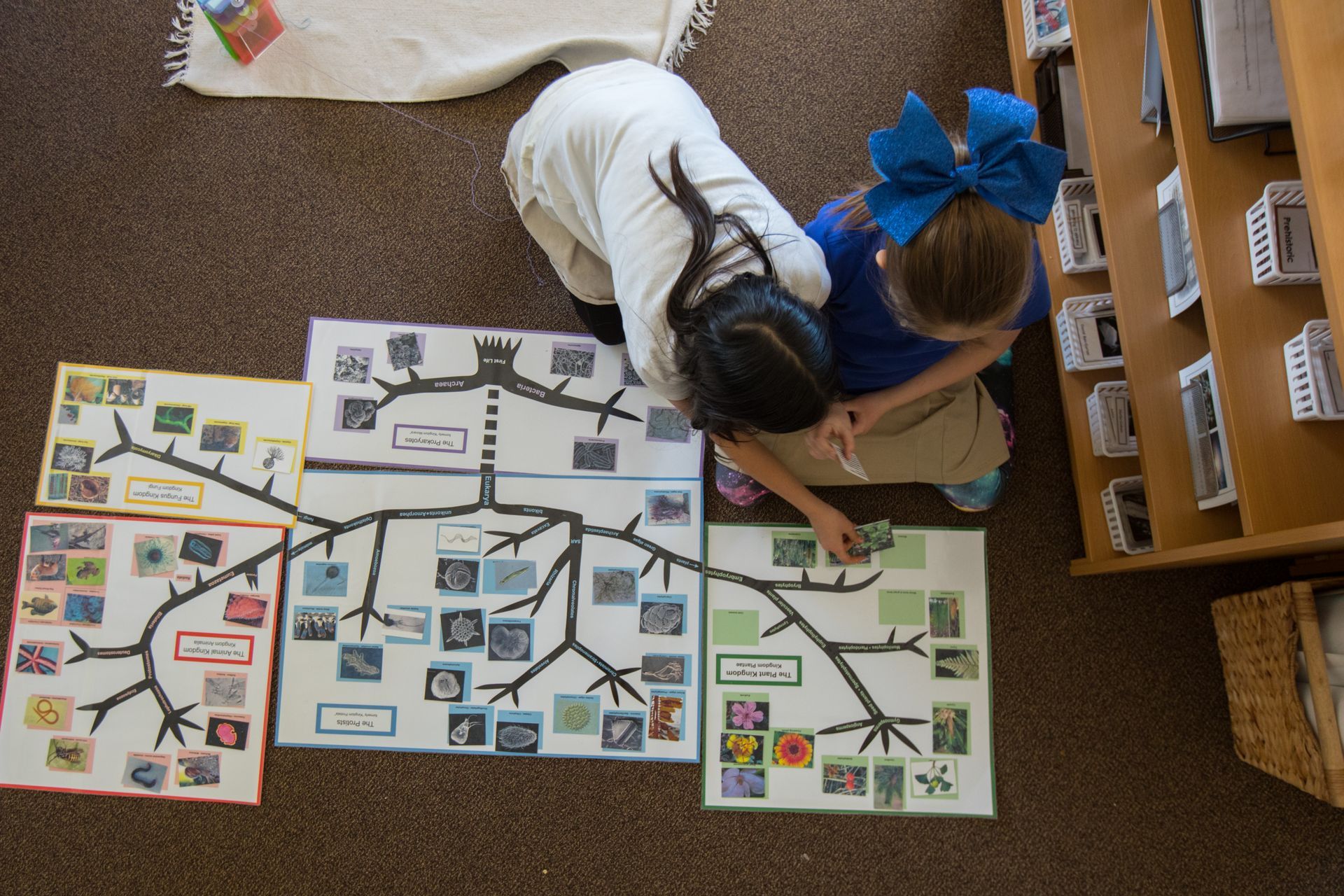
Throughout the elementary years, our students explore biology, earth science, astrophysics, ancient civilizations, and human history. These are precisely the topics children long to explore at this stage, giving us a powerful window of opportunity.
"Since it has been seen to be necessary to give so much to the child, let us give him a vision of the whole universe. The universe is an imposing reality, and an answer to all questions."
— Dr. Maria Montessori
Imagination and Intelligence: Moving Beyond the Concrete
A core principle of Montessori education is that concrete hands-on experiences precede abstract understanding. In Primary, children spend hours manipulating tactile materials. In Elementary, while concrete materials remain essential for introducing new concepts, students begin transitioning toward abstract thinking.
Experiencing concepts with their hands first ensures that their later, abstract understanding is grounded, deep, and meaningful.
"Children show a great attachment to the abstract subjects when they arrive at them through manual activity."
— Dr. Maria Montessori
As children grow older, their capacity for imagination expands dramatically. In Montessori, imagination is distinct from fantasy. Fantasy involves myths, dragons, and mermaids; imagination is the mind’s ability to picture concepts it cannot see directly—like the vastness of space, the movement of tectonic plates, or life millions of years ago.
"The secret of good teaching is to regard the child’s intelligence as a fertile field in which the seeds may be sown, to grow under the heat of flaming imagination. Our aim therefore is not merely to make the child understand, and still less to force him to memorize, but to touch his imagination as to enthuse him to his inmost core."
— Dr. Maria Montessori
Giving Them the Universe: The Five Great Lessons
To light the spark of imagination, the Elementary journey at MANJ begins with The Five Great Lessons. These are dramatic, impressionistic stories designed to ignite wonder, offer a grand vision of the universe, and serve as a springboard for year-long research.
1. The Coming of the Universe
The first Great Lesson introduces the cosmos. Children gather in a darkened room as the guide tells the story of the universe's origin—from cold darkness to a great "flaring forth." When a black balloon is popped, sending glitter across the room, the children catch a glimpse of the Big Bang, the formation of stars, the birth of Earth, and early volcanic activity.
In the weeks following, students conduct simple physics and chemistry experiments left on the shelves, exploring states of matter, gravity, and space.
2. The Coming of Life
The second Great Lesson introduces the story of life on Earth, exploring how ancient organisms evolved over time. Dr. Montessori viewed all living things as having an innate "cosmic task"—a role that contributes to the broader ecosystem while the organism simply goes about its daily survival.
"All creatures work consciously for themselves, but the real purpose of their existence remains unconscious, yet claiming obedience."
— Dr. Maria Montessori
For example, ancient shellfish removed excess calcium from the oceans to form their shells, early plants created oxygen for animal life, and decaying matter enriched the soil. Children learn that every living thing plays a role in sustaining the planet.
3. The Coming of Human Beings
This lesson explores the arrival of early humans, focusing on the gifts that set humanity apart: a mind to imagine, a heart to love, and hands to create and use tools.
4. The Story of Writing
Students learn how human communication evolved from cave paintings and Egyptian hieroglyphics to early alphabets, sparking a deep appreciation for language and literacy.
5. The Story of Numbers
This story traces the history of mathematics from early tally marks to the invention of zero and modern base-ten systems, showing students that math is a shared human invention designed to solve real-world problems.
The Broader Purpose of Cosmic Education
Cosmic Education is not just an academic framework—it is a foundation for character, empathy, and global citizenship. By helping children see how interconnected the universe is, we cultivate a sense of gratitude, stewardship, and moral responsibility.
"It is not enough to ensure for the child food, clothing and shelter; on the satisfaction of his more spiritual needs the progress of humanity depends—the creation indeed of a strong and better humanity."
— Dr. Maria Montessori
When children understand the grand story of life, they begin to understand their own potential to contribute positively to the world around them.
Connect With Us
We love sharing the depth of our Elementary program with our community! If you have questions about how Cosmic Education comes to life in our classrooms or would like to
schedule a visit, please
reach out to our team at
Montessori Academy of New Jersey.