
We Can Serve as Guides
February 19, 2024

As adults, we often step into particular kinds of roles with children. We can be parents, aunts, uncles. We can be coaches, mentors, teachers. Each role has a set of expectations, often with an unspoken rule that the adult knows best and that children will learn from us.


Yet the roles adults can play in children’s lives can be much more nuanced. We can facilitate, suggest, model, and observe. The world can teach and the adults can serve as guides in a process of learning and discovery.


Be Curious


In the Positive Discipline approach, adults guide growth and learning by asking “curiosity questions.” The key is not to rely on scripted questions but rather to be genuinely curious, perhaps asking questions like:


  • How do you feel about what happened?
  • What were you trying to accomplish?
  • What did you learn?
  • How do you think you might use what you learned?
  • What ideas do you have for solutions?


Avoiding the question “why?” is also important as it can sound accusatory and can lead to a child feeling defensive.


Sometimes a young person in our life is struggling, perhaps lashing out verbally or doing everything they can emotionally hurt others. If we can wonder what might be behind their behavior, we can shift our approach. We can also be curious about what we want or need in the interaction. For example, sometimes when a young person is struggling, we just want to know how we can help that person feel better. If that is the case, we can ask the question full-heartedly: “What can I do to help you have a better day?” 


Shift to Support


When we shift our roles and think about how to learn more about what our children are feeling, thinking, and exploring, we become meaningful guides. Rather than dispensing information, we can help children make discoveries. This is an essential part of what Montessori teachers do each day in our learning communities. 


For example, elementary-aged children often make amazing connections in their learning. An elementary student can be ecstatic due to a discovery about the periodic table, as recently happened with a young learner: “Look!” she exclaimed. “Gold has the symbol Au, because the Latin name for gold is aurum. Au for aurum!” Because this young person had discovered this connection on her own, the knowledge was so much more invigorating and inspiring than had an adult instructed her about etymology and periodic table symbols. 


Honor the Process


In How Children Learn, John Holt describes children’s process of learning: “The child is curious. He wants to make sense of things, find out how things work, gain competence and control over himself and his environment, and do what he can see other people doing. He is open, perceptive, and experimental. He does not merely observe the world around him. He does not shut himself off from the strange, complicated world around him, but tastes it, touches it, hefts it, bends it, breaks it. To find out how reality works, he works on it. He is bold. He is not afraid of making mistakes. And he is patient. He can tolerate an extraordinary amount of uncertainty, confusion, ignorance, and suspense.”


Children naturally want to figure out the world and themselves. Thus, we can be thoughtful guides through this remarkable world of ours. We can entice. We can inspire. We can show possible paths. 


In our Montessori classrooms, we recognize the incredible power in children’s process of experimenting, observing, making mistakes, and experiencing the world around them. Rather than serve as the experts dispensing knowledge, we act as guides. 


Curious to see how the role of adults can shift? Schedule a tour to see how we support children in nuanced ways.
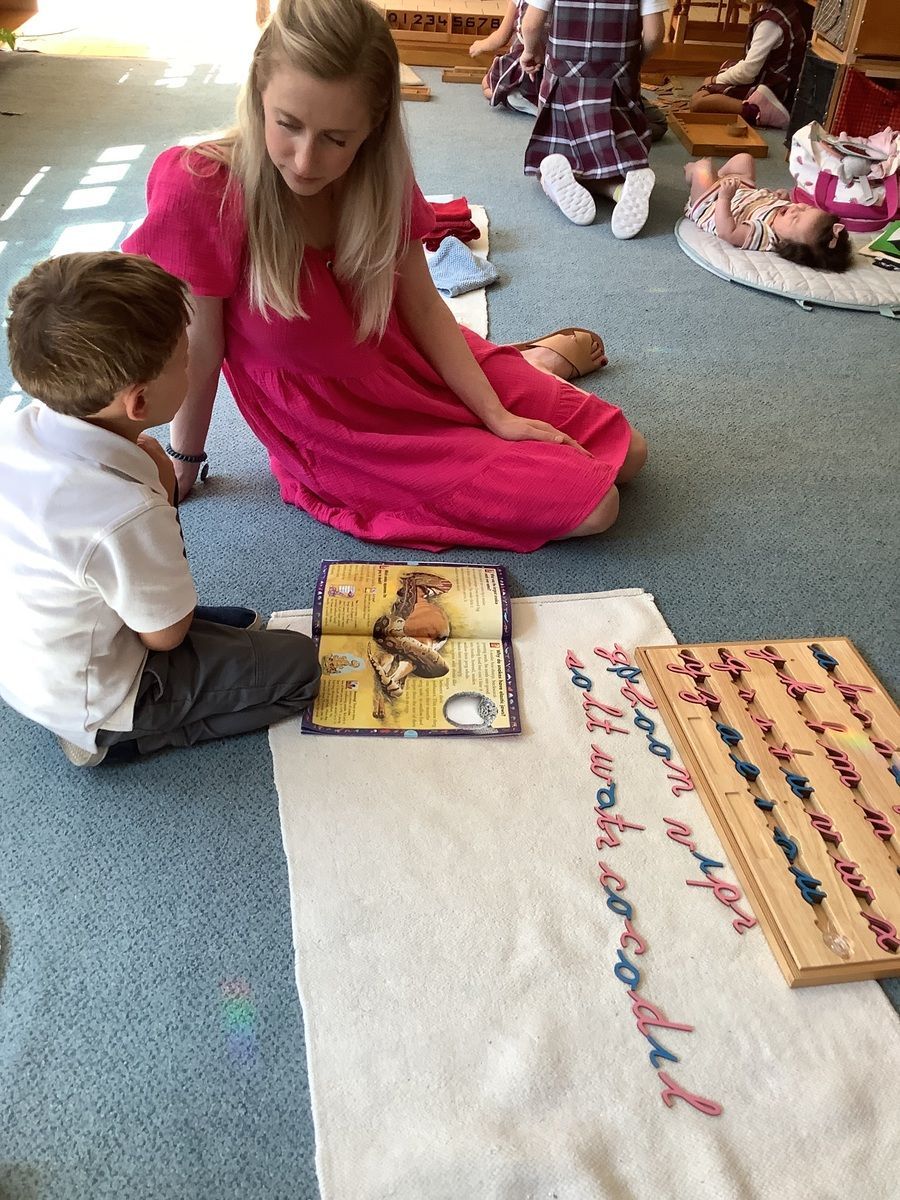

Teacher reading with young children, modeling attentive adult presence in early learning.
March 16, 2026
A child’s early learning is shaped by the presence of the adults around them. This post explores how mindful movement, language, and boundaries support security and independence in the early years.
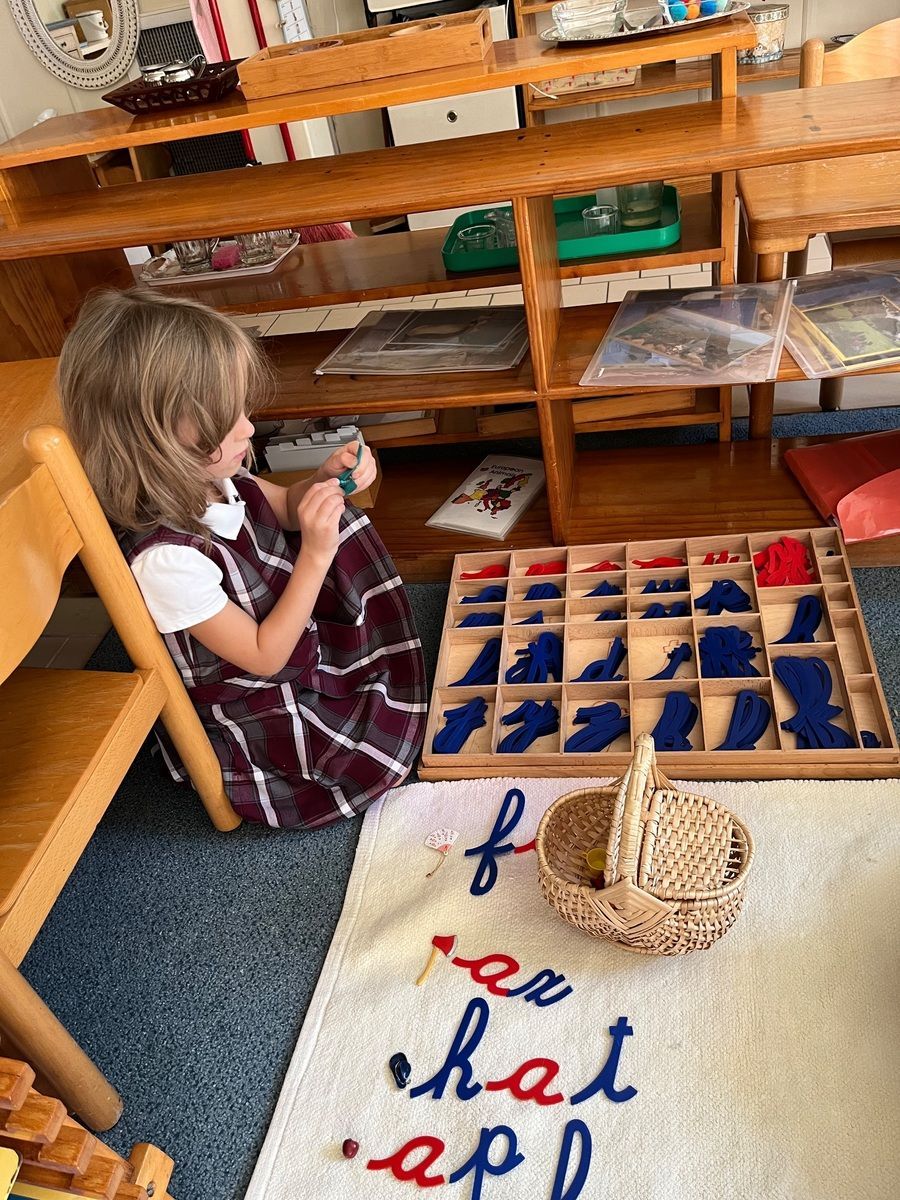
Child using color-coded word cards to explore pronouns in a Montessori language activity.
March 9, 2026
When children begin working with pronouns in Montessori, they are not learning something entirely new. Instead, they are bringing to consciousness language they already use every day. Pronoun work builds slowly and intentionally. It is not about mastering grammar rules, but about understanding how language functions and how meaning is carried when words stand in for one another. Beginning With Experience, Not Explanation Montessori pronoun work begins with movement and spoken language, not written grammar. We start with little oral games to highlight how a pronoun functions, sometimes eliminating the pronoun (“Josie and John and Jack and Josiah are walking around the table.”) and other times emphasizing the pronoun (“They are walking around the table.”). The children love acting out the phrases, sometimes chanting, moving, watching one another, and laughing. Through these physical experiences, they begin to notice that we don’t always use names when we speak. Certain words take the place of a noun, and the meaning is still clear. At this stage, we don’t offer the term pronoun because we want children to simply experience its function. From Movement to Sentences Once children are ready for more structured language work, we introduce them to the Pronoun Grammar Box so they can build and rebuild sentences using color-coded cards for each part of speech. From one sentence to the next, only a few words change as nouns get replaced by pronouns. By comparing sentences, children discover that although the word changes, the sentence still makes sense. This comparison is essential. Rather than being told what a pronoun is, children see what it does. We then invite children to add grammar symbols to the sentence (noun, article, adjective, verb, preposition, adverb) until we finally draw attention to the remaining word: “This word is used in place of a noun.” Only then do we introduce the pronoun symbol: a purple isosceles triangle, the height of the noun symbol. Montessori Lore: The Pronoun’s Story There’s a beloved story about the pronoun symbol. Long ago, the pronoun was shorter and a different color. Wanting to be as important as the noun, it stretched itself taller and taller to reach the same height. As it stretched, its base became smaller and it turned purple from the effort of standing in the noun’s place. It’s a poetic reminder of what children discover through their work: a pronoun depends on the noun, borrowing its meaning while standing in for it. Why Pronouns Come Later Pronouns are more abstract than other parts of speech. To understand a pronoun, children must already have a strong, concrete understanding of the noun. For this reason, pronouns (along with interjections) are typically introduced later than other grammar symbols, often in the elementary years. Even then, one lesson is not enough. In Montessori, the real learning happens after the presentation, when we step back and children work independently with the material. The guide’s role is to show how to use the material, not to explain grammar in detail. Understanding emerges through repeated use. Deepening Understanding Through Play and Exploration As children grow more confident, the work expands to include: Transposition games, where pronouns are removed or replaced to explore how meaning changes. Command cards, which physically isolate pronouns through action. Personal pronoun charts, introducing first, second, and third person (singular and plural) through storytelling. The Verb Family, where children explore the close relationship between the verb, adverb, and pronoun. Children discover that pronouns often work closely with verbs, helping to carry action and meaning through a sentence. Subtleties Come Later At first, Montessori avoids getting caught in fine distinctions. Over time, children may explore nuances such as the difference between possessive pronouns (the book is mine) and possessive adjectives (my book). These discussions often happen later, sometimes with the support of grammar references, once children have a solid foundation. Language Revealed, Not Taught Through this carefully layered progression of movement, sentence work, symbols, and exploration, children develop a deep understanding of how words function differently in sentences. Montessori grammar invites children to discover how language works at their own pace through hands-on exploration. We don’t rush this process. So by the time children are ready to name the pronoun, it’s not a new idea. It’s something they already know. We invite you to visit our classrooms in Delran, New Jersey to see firsthand the children’s joy of learning!