We’ve all seen those moments when children are intensely fascinated by something. Maybe it’s when our toddler insists on opening and closing every door, or our little one spends hours lining up toys just so.
Dr. Maria Montessori noticed these exact patterns more than a century ago, and her observations became one of the cornerstones of the Montessori approach to early childhood education: the Sensitive Periods.
What Are Sensitive Periods?
Sensitive periods are among the great “superpowers” of the first six years of life. Dr. Montessori observed that at certain points in their lives, children are irresistibly drawn to a particular activity or aspect of the environment.
During these periods, children return to the experience again and again, and with joy and persistence. Then, one day, the interest fades, and a new fascination takes its place.
Rather than just a random part of childhood, this draw to certain experiences is key to development, which unfolds through transitory windows of opportunity, when the brain is especially receptive to mastering specific skills. Today, neuroscience calls these “critical periods.” Dr. Montessori simply called them Sensitive Periods.
The Four Major Sensitive Periods
Dr. Montessori identified several recurring sensitive periods in the first six years of life. Here are the four most universal and defining ones, and what they mean for your child.
The Sensitive Period for Language
From the moment of birth, children’s ears are tuned to the sound of the human voice. Even before speaking, babies listen intently, absorbing the rhythm, tone, and melody of language.
This sensitive period begins at birth and lasts well into the elementary years, though it is most intense in the first six years.
From birth to three years, children are laying the foundation for language, listening, experimenting, and creating their first spoken words.
Between the ages of two and five, their vocabulary expands rapidly as they refine grammar and pronunciation.
From ages four and a half to six, children begin to explore language consciously: how it works, how words can be used to communicate, and even how language can influence others.
To develop language, children need a rich environment full of meaningful human conversation. We can offer this through stories, songs, and daily dialogue. Every conversation around a meal, every story shared before bedtime, and even every answer to “why?” Feeds this deep inner work.
The Sensitive Period for Order
Have you noticed how young children can become deeply upset when their routine changes or when you move their favorite cup? Although it may seem like stubbornness, it’s actually a sign of the Sensitive Period for Order, which peaks between ages two and three.
For young children, order is not just a preference. It is a strong need. Order helps young children make sense of a world that can otherwise feel chaotic. Predictability allows them to feel safe and secure.
Two forms of order develop simultaneously:
External order: The arrangement of the environment, such as where things are, when events happen, and how routines unfold.
Internal order: The organization of children’s own body and mind, such as understanding where their limbs are, how they move, and how thoughts and actions connect.
When order is consistent, children’s developing minds can focus on exploration and learning.
The Sensitive Period for Movement
Although it may seem like just a physical activity, movement is also children’s way of building intelligence. From rolling over to walking, from grasping to pouring, each movement strengthens the connection between body and mind.
This sensitive period begins before birth and continues through early childhood, evolving from gross motor coordination (such as whole-body movement) to fine motor control (such as use of the hand).
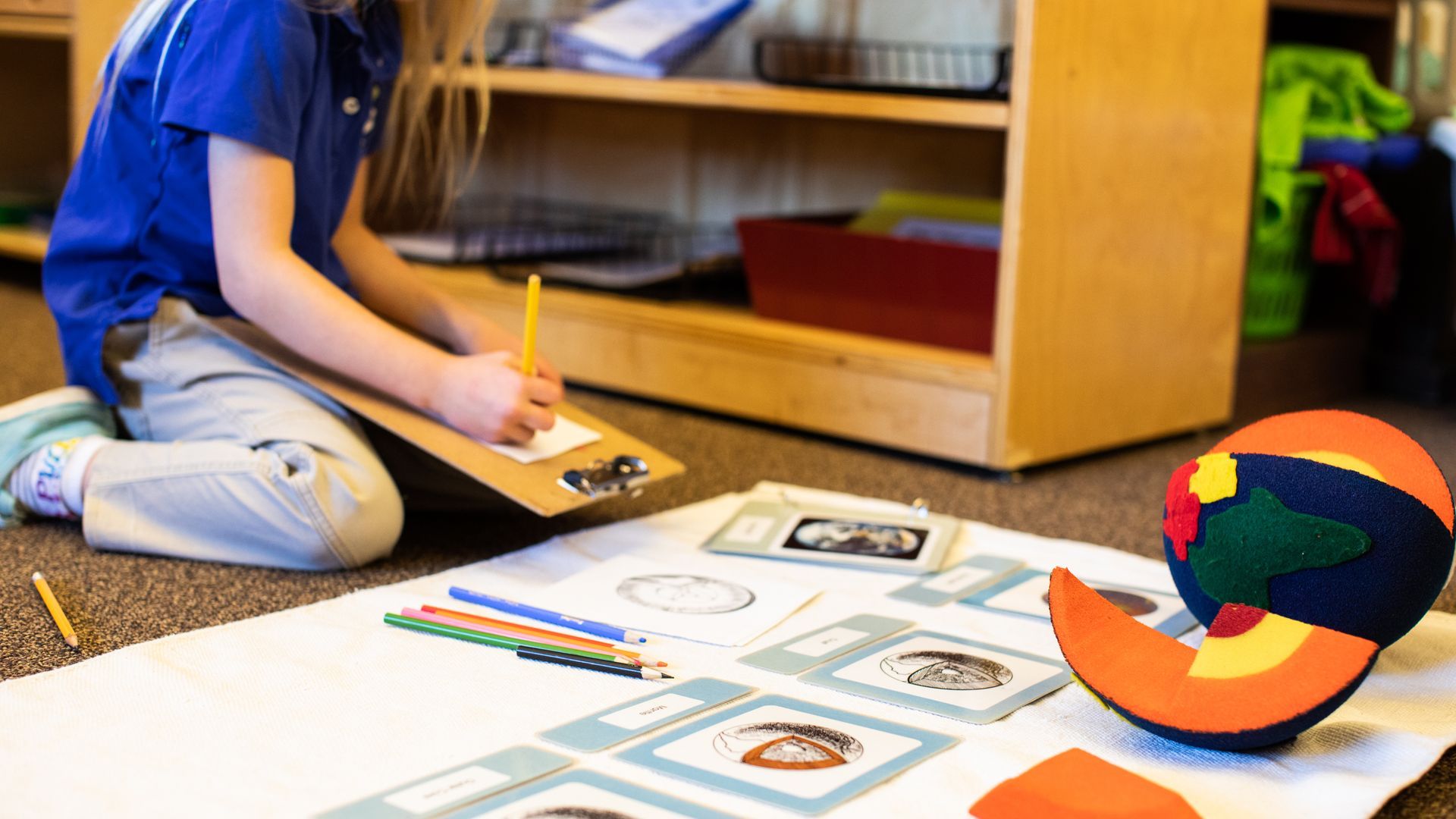
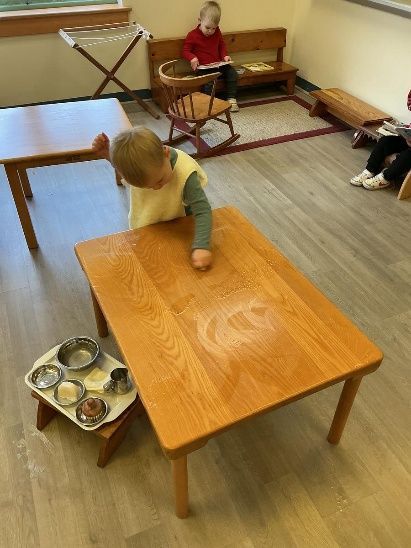
In Montessori, we consider the hand to be the “instrument of the mind.” Through purposeful activity, like carrying, pouring, scrubbing, and buttoning, children not only refine movement but also develop concentration, willpower, and independence.
Between the ages of two and a half and six, this sensitive period focuses on refining and perfecting movement. We see this as children observe and imitate the movements of adults. Through repetition and practice, children are learning to control their bodies purposefully. They are beginning to integrate their will and their movement.
Children today often need extra opportunities to strengthen their hands and bodies. Offering them the simple, practical work of daily life, whether climbing, kneading dough, squeezing sponges, or opening jars, is incredibly beneficial to their development!
The Sensitive Period for Refinement of the Senses
Children first learn about the world through their senses: touch, taste, smell, sight, and hearing. The Sensitive Period for Refinement of the Senses begins at birth and peaks around age four and a half, continuing into the primary years.
During this time, children are not just taking in sensory impressions but also learning to discriminate between them by noticing subtle differences in color, sound, texture, weight, and shape.
This refinement doesn’t improve children’s eyes or ears physically. Rather, it sharpens the mind’s ability to classify and compare. Through these experiences, children develop keen observation, attention to detail, and a love of beauty. Sensorial foundations become the basis for imagination, scientific thinking, and aesthetic appreciation later in life.
When a Sensitive Period Comes to an End
When a sensitive period has fulfilled its purpose, children’s interest in that particular type of work fades. Their joy of mastery leads to a deep sense of satisfaction and peace.
We see this when children smile proudly after accomplishing a task they’ve been working on for weeks, or when they move gracefully from one activity to another with newfound confidence. When children feel fulfilled in their developmental work, they naturally show more calmness, cooperation, and kindness toward others.
How We Can Support Sensitive Periods at Home
Sensitive periods remind us that timing matters in child development. A young child’s urges, like to repeat, to order, to move, or to talk, are not random behaviors to manage but signs of deep, inner, and purposeful work.
Our task as adults is to support our children in this development. To reframe our thinking and approach, we can:
- Try to observe with curiosity. When your child repeats something endlessly, ask, “What skill is being built here?” rather than trying to redirect.
- Provide freedom within structure. Offer choices within consistent routines.
- Prepare an orderly environment. Keep spaces simple, beautiful, and predictable.
- Invite real activity. Give your child tools and time to participate in daily life by washing, cooking, caring for plants, or setting the table.
- Speak and move with clarity. Our words and actions are powerful models during these sensitive periods.
A Closing Thought
Sensitive periods are nature’s way of guiding our children toward independence and wholeness. When we understand and honor the sensitive periods, we align with children’s natural development rather than working against it.
By recognizing and respecting these inner guides, we help our children grow with joy, purpose, and peace. To see how we fully support the natural rhythm of children’s own becoming, schedule a visit to our school here in Delran.