
Montessori Materials Explained: The Flat Bead Frame
December 1, 2025
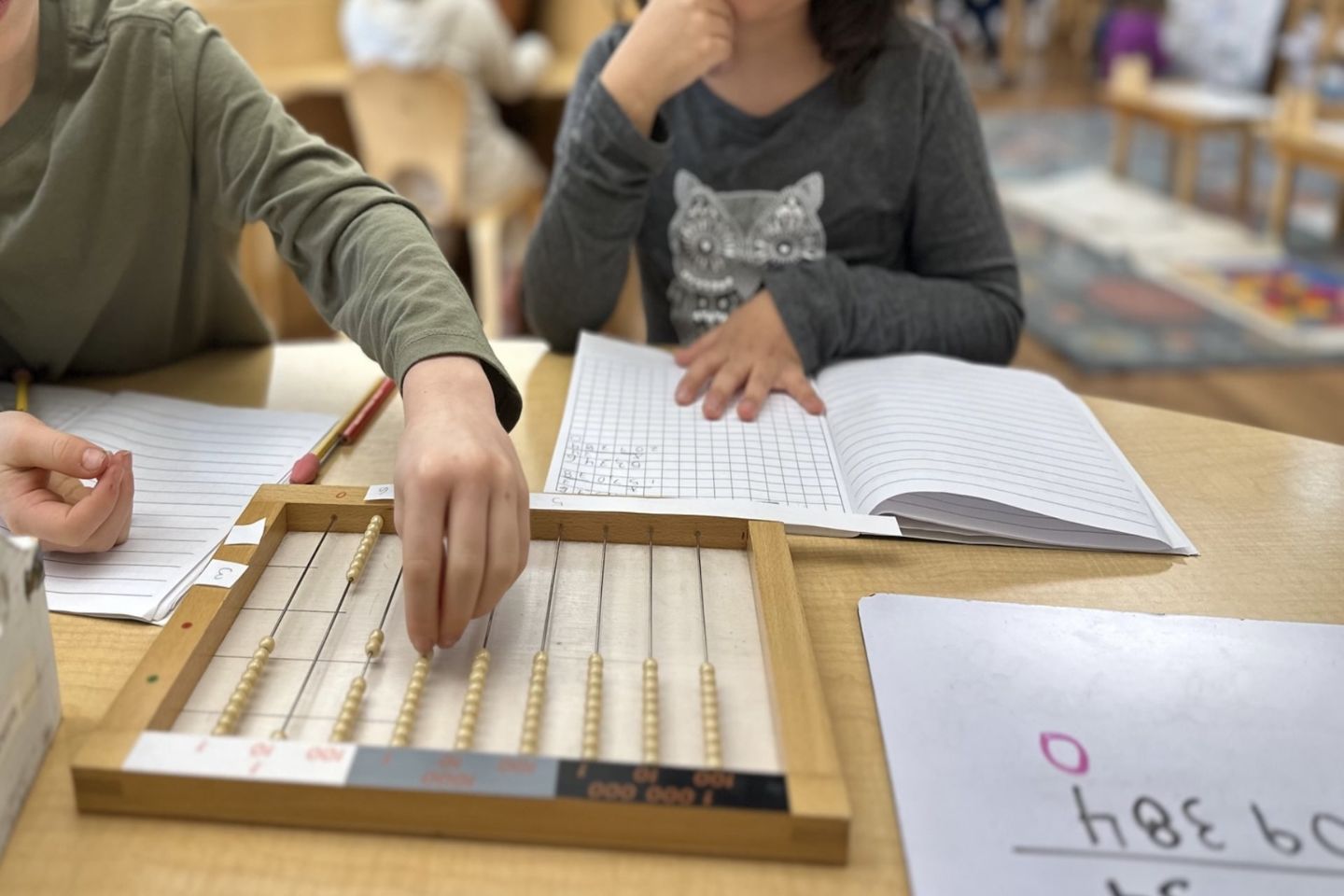
Child using Montessori Flat Bead Frame to explore large-number multiplication through hands-on math.

The Flat Bead Frame, also known as the Horizontal Bead Frame or Golden Bead Frame, is one of the most elegant bridges between the concrete and the abstract in the Montessori elementary math curriculum. It allows children to work with very large numbers, up to the hundreds of millions, while continuing to manipulate tangible representations of each place value. 


Unlike many elementary materials designed for group exploration, this work is typically done individually (or with a partner), offering quiet moments of concentration and reflection amid the classroom’s collaborative hum.


From the Large Bead Frame to the Flat Bead Frame


At first glance, the Flat Bead Frame looks similar to the Large Bead Frame, but it represents a significant step forward in abstraction. The Large Bead Frame has seven horizontal wires and color-coded beads arranged by the simple, thousands, and millions period, thereby emphasizing the hierarchical nature of the decimal system. 


In contrast, the Flat Bead Frame is organized vertically, with nine columns of golden beads, all identical in color, representing units through one hundred millions. The numerical categories are written across the top, and red zeroes are printed along the bottom to highlight the effect of multiplying by powers of ten. The golden color of the beads makes the material more symbolic, signaling that the child is now ready to move away from concrete color coding toward pure quantity and value.


Introducing the Material: Connecting the Known to the New


When introducing this material, we often begin by inviting a child to compare it with the Large Bead Frame. This connection helps the child orient to what is familiar while noticing what is new: the vertical organization, the placement of numbers, the red zeros, and the use of golden beads instead of hierarchical colors. 


The child then begins with a simple multiplication problem, like 1,246 × 3. We write the multiplicand on a paper strip and place it beneath the wires so that each digit aligns with its corresponding place value. Using gray number cards or slips of paper for the multiplier, the child then moves the beads to represent each partial product. The process is rhythmic and deliberate: 6 units three times is 18 units (eight units and one ten)… 4 tens three times is 12 tens (four tens and one hundred)… The movement of beads down the frame creates a clear, physical representation of the multiplication process.


Moving Toward Abstraction: Powers of Ten in Action


As the child progresses, the Flat Bead Frame becomes a tool for exploring long multiplication (also called compound multiplication) and multiplication by powers of ten. When the multiplier contains tens, hundreds, or thousands, the child learns to physically shift the multiplicand to the left—mirroring the way zeros are added in written notation. The red zeroes along the base of the frame make this concept immediately visible. What might otherwise be a rote rule (“just add a zero”) becomes an embodied experience of place value and the movement of quantity through hierarchical orders.


A Continuation of Earlier Montessori Work


This material builds on experiences children had with the Bank Game at the primary level, when they would work as a group to exchange quantities of 10 for the next category. On the Flat Bead Frame, however, the work becomes deeply personal and precise. It requires concentration, accuracy, and an understanding of the relationships between categories. These qualities help build the foundation for true mathematical abstraction.


The Mathematical Mind in Motion


Through this work, children reinforce their multiplication facts, internalize the commutative law, and gain confidence in working with large numbers. More importantly, they begin to grasp that mathematics follows a consistent and logical structure, one they can visualize, manipulate, and eventually imagine without the aid of concrete materials.


A Quiet Revelation


The Flat Bead Frame exemplifies Montessori’s belief that “the hand is the instrument of the mind.” As children move the golden beads, their understanding of place value and multiplication deepens. The process of working with the Flat Bead Frame provides children with a conceptual leap from seeing mathematics as a set of operations to recognizing it as a beautifully ordered system. 


Visit us in Delran to see how what begins as a physical exercise in moving beads becomes, over time, a quiet revelation and a process of mathematical thinking. This is Montessori math at its best!
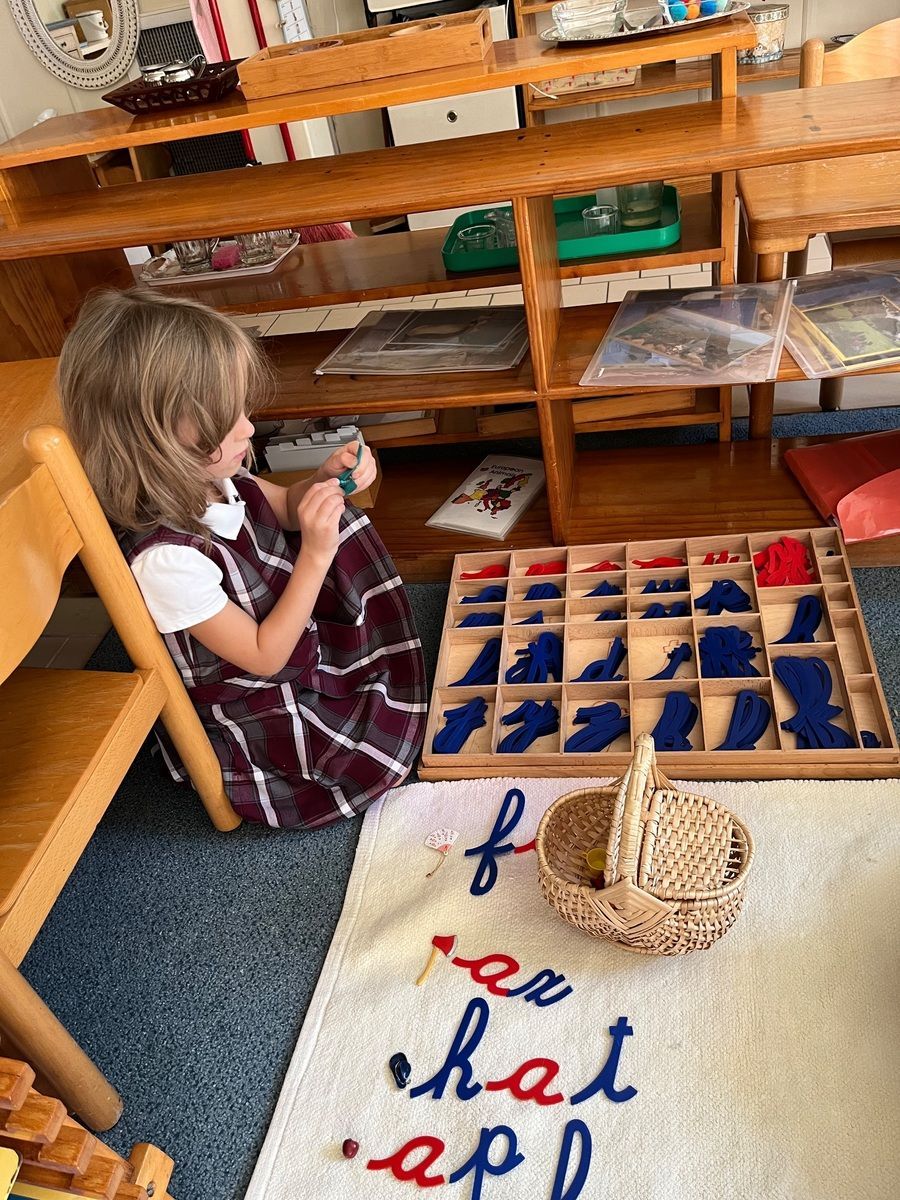

Child using color-coded word cards to explore pronouns in a Montessori language activity.
March 9, 2026
When children begin working with pronouns in Montessori, they are not learning something entirely new. Instead, they are bringing to consciousness language they already use every day. Pronoun work builds slowly and intentionally. It is not about mastering grammar rules, but about understanding how language functions and how meaning is carried when words stand in for one another. Beginning With Experience, Not Explanation Montessori pronoun work begins with movement and spoken language, not written grammar. We start with little oral games to highlight how a pronoun functions, sometimes eliminating the pronoun (“Josie and John and Jack and Josiah are walking around the table.”) and other times emphasizing the pronoun (“They are walking around the table.”). The children love acting out the phrases, sometimes chanting, moving, watching one another, and laughing. Through these physical experiences, they begin to notice that we don’t always use names when we speak. Certain words take the place of a noun, and the meaning is still clear. At this stage, we don’t offer the term pronoun because we want children to simply experience its function. From Movement to Sentences Once children are ready for more structured language work, we introduce them to the Pronoun Grammar Box so they can build and rebuild sentences using color-coded cards for each part of speech. From one sentence to the next, only a few words change as nouns get replaced by pronouns. By comparing sentences, children discover that although the word changes, the sentence still makes sense. This comparison is essential. Rather than being told what a pronoun is, children see what it does. We then invite children to add grammar symbols to the sentence (noun, article, adjective, verb, preposition, adverb) until we finally draw attention to the remaining word: “This word is used in place of a noun.” Only then do we introduce the pronoun symbol: a purple isosceles triangle, the height of the noun symbol. Montessori Lore: The Pronoun’s Story There’s a beloved story about the pronoun symbol. Long ago, the pronoun was shorter and a different color. Wanting to be as important as the noun, it stretched itself taller and taller to reach the same height. As it stretched, its base became smaller and it turned purple from the effort of standing in the noun’s place. It’s a poetic reminder of what children discover through their work: a pronoun depends on the noun, borrowing its meaning while standing in for it. Why Pronouns Come Later Pronouns are more abstract than other parts of speech. To understand a pronoun, children must already have a strong, concrete understanding of the noun. For this reason, pronouns (along with interjections) are typically introduced later than other grammar symbols, often in the elementary years. Even then, one lesson is not enough. In Montessori, the real learning happens after the presentation, when we step back and children work independently with the material. The guide’s role is to show how to use the material, not to explain grammar in detail. Understanding emerges through repeated use. Deepening Understanding Through Play and Exploration As children grow more confident, the work expands to include: Transposition games, where pronouns are removed or replaced to explore how meaning changes. Command cards, which physically isolate pronouns through action. Personal pronoun charts, introducing first, second, and third person (singular and plural) through storytelling. The Verb Family, where children explore the close relationship between the verb, adverb, and pronoun. Children discover that pronouns often work closely with verbs, helping to carry action and meaning through a sentence. Subtleties Come Later At first, Montessori avoids getting caught in fine distinctions. Over time, children may explore nuances such as the difference between possessive pronouns (the book is mine) and possessive adjectives (my book). These discussions often happen later, sometimes with the support of grammar references, once children have a solid foundation. Language Revealed, Not Taught Through this carefully layered progression of movement, sentence work, symbols, and exploration, children develop a deep understanding of how words function differently in sentences. Montessori grammar invites children to discover how language works at their own pace through hands-on exploration. We don’t rush this process. So by the time children are ready to name the pronoun, it’s not a new idea. It’s something they already know. We invite you to visit our classrooms in Delran, New Jersey to see firsthand the children’s joy of learning!
Newborn baby sleeping peacefully, illustrating Montessori-inspired healthy infant sleep.
March 2, 2026
Sleep is a skill children develop with support, trust, and preparation. This reflection explores how Montessori philosophy aligns with sleep science to support healthy rest for children and parents.