Elementary Story: How Geometry Got Its Name
January 26, 2026
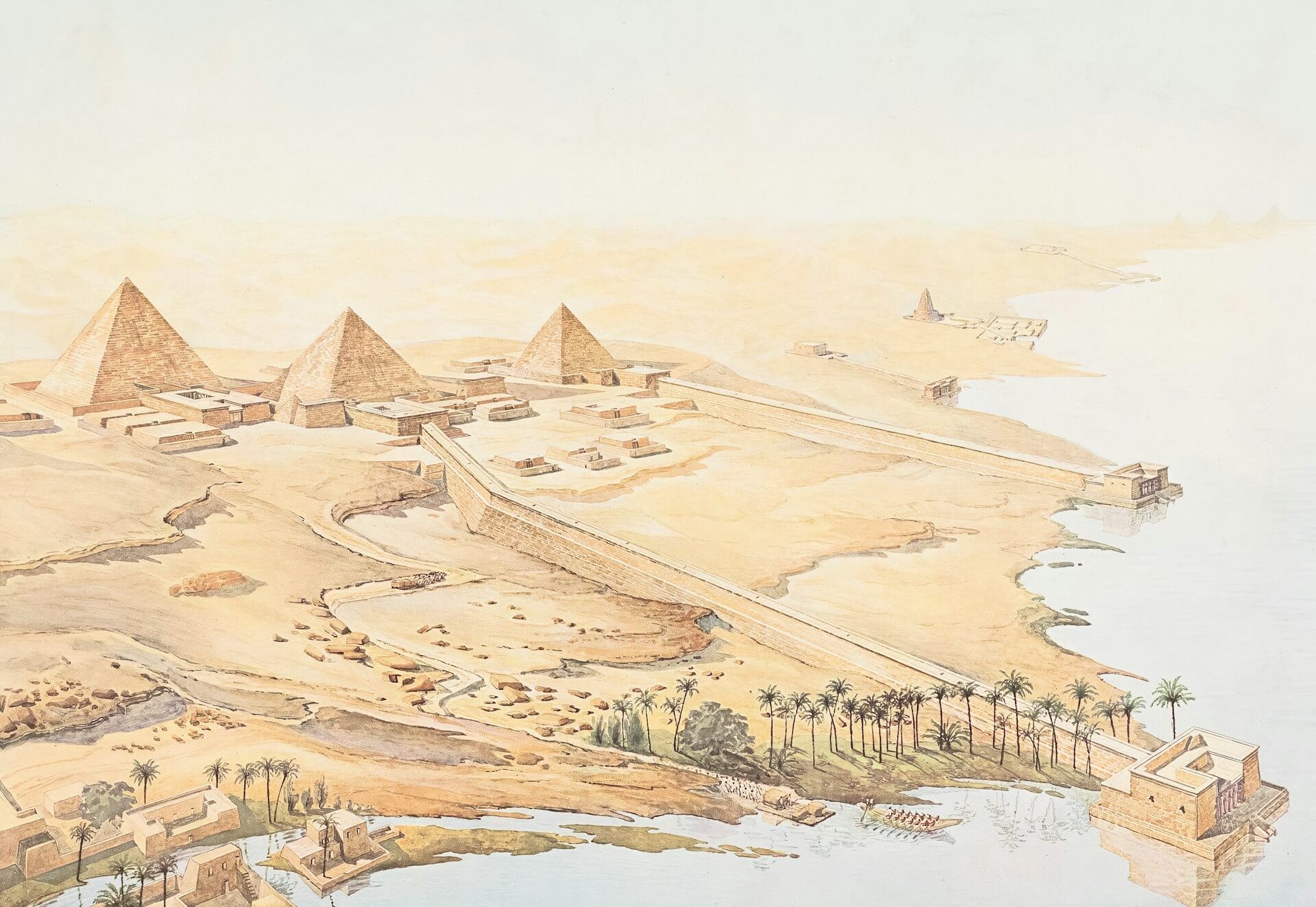
Illustration of ancient Egypt with pyramids and waterways, showing early geometry origin

In Montessori elementary classrooms, we like to introduce big ideas with big stories. We offer children a sense of wonder first, sort of like an imaginative doorway, so that when they later study formulas, theorems, and proofs, they already feel connected to the human story behind them.


One of these stories is The Story of How Geometry Got Its Name, an introduction to a subject that is far older than the textbooks and protractors we encounter today. In Montessori, Geometry is more than about shapes. It is about human beings solving real problems in the real world.


A Problem as Old as Civilization


To introduce geometry, we take children about five thousand years back in time to the ancient civilization of Egypt. This was a land shaped by the Nile, the longest river in the world. Each year, the Nile flooded its banks as snowmelt poured down from the mountains far to the south. The Egyptians depended on this yearly flood as it left behind rich, dark silt that nourished their crops and made life possible in an otherwise harsh desert.


But the flood created a challenge, too. It washed away the boundary markers that separated one farmer’s field from another. When the waters receded, no one could quite remember where their land began and ended. Arguments ensued. “This corner is mine!” And the fields needed to be measured and marked again.


The First Geometers: The Rope Stretchers


To solve this annual problem, the Egyptians relied on a special group of skilled workers called the Harpedonaptai, or Rope Stretchers. These were early land surveyors who used a knotted rope tied at regular intervals and three weights to create a very particular triangle.


In the classroom, we invite a few children to hold a prepared rope at its large knots, forming that same triangle. As they stretch it out and lay it on the ground, many quickly recognize what the Egyptians had unknowingly created: a scalene right-angled triangle. This shape would later become central to the geometry studied by Greek mathematicians.


The Rope Stretchers used this simple tool to re-establish field boundaries, set right angles, and make sure the land was measured accurately and fairly. Geometry, in its earliest form, served a deeply practical purpose.


From Rope to Pyramid


The Rope Stretchers’ expertise was valued far beyond the farmlands. They also helped lay out the foundations of temples, monuments, and even the Great Pyramid of Giza. The base of the Great Pyramid is a perfect square, which is an astonishing feat of measurement and design. The Pharaoh himself oversaw these measurements, but it was the Rope Stretchers who executed them.


Their work represents one of humanity’s earliest recorded sciences: the careful measuring of the earth.


How Geometry Got Its Name


The name geometry reflects this ancient practice. It comes from two Greek words:


— earth

metron — measure


Geometry literally means earth measurement.


The Egyptians did not use the language of right angles, nor did they classify triangles as we do today. Their work was grounded in practical needs. They needed to solve problems, organize land, and create structures that would endure for thousands of years. Yet their discoveries influenced later thinkers like Pythagoras, who likely traveled to Egypt and learned from their methods. Over time, the simple knotted rope inspired a whole discipline devoted to understanding lines, angles, shapes, and the relationships between them.


Why We Tell This Story in Montessori


When Montessori children hear this story, something important happens. Geometry becomes more than a set of rules or vocabulary words. It becomes a human endeavor born from curiosity, necessity, and ingenuity.


This is the heart of Montessori’s cosmic education: helping children see knowledge not as isolated subjects, but as gifts from generations before them. When children pick up a ruler, explore angles with a protractor, or classify triangles in the classroom, they are continuing a legacy that began with those early Rope Stretchers on the banks of the Nile.


Through story, children feel connected to the people who shaped our world and to the problems that inspired great ideas. Schedule a tour today to see how geometry becomes meaningful, purposeful, and alive for our children here in Delran, N.J.
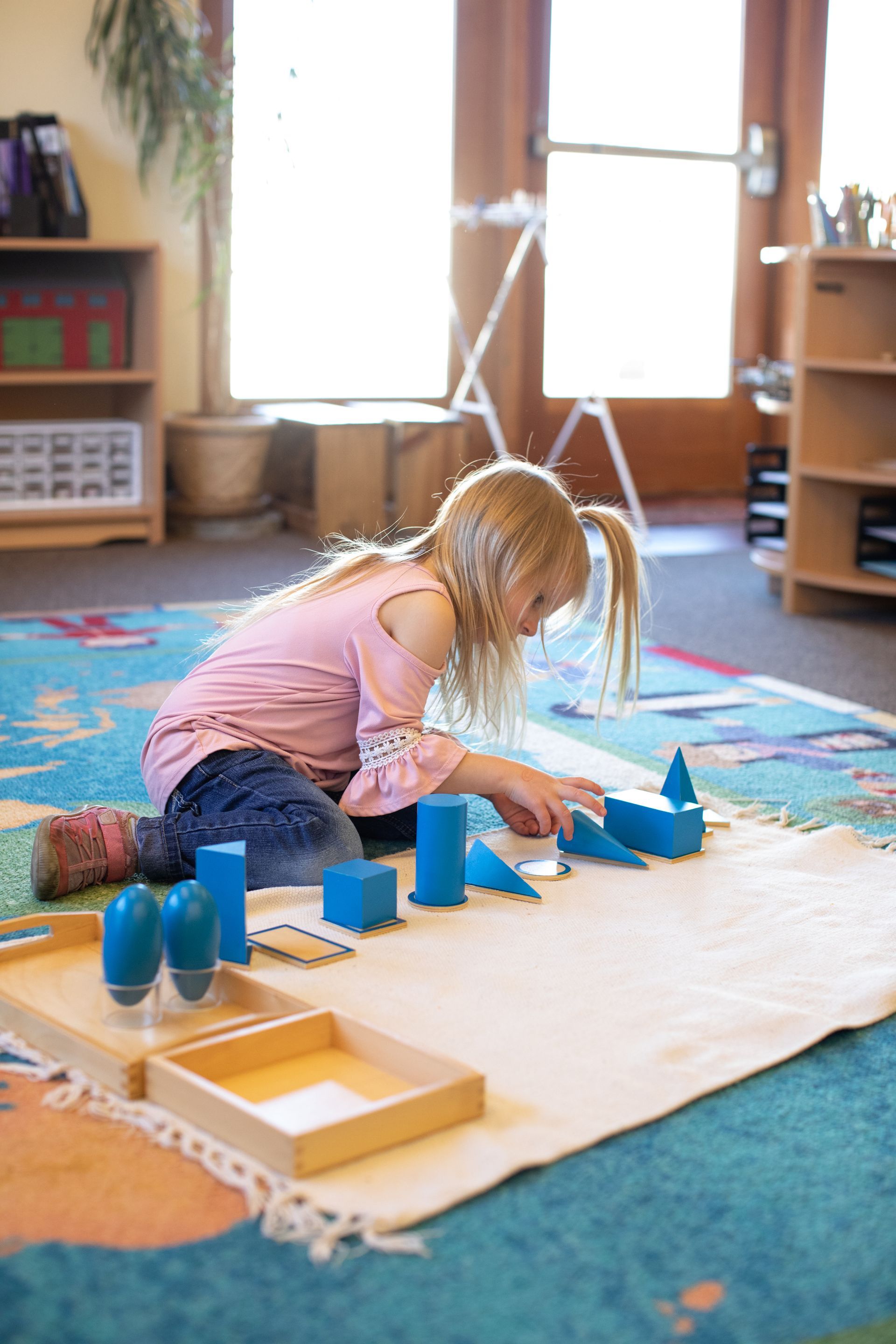

Child using color-coded word cards to explore pronouns in a Montessori language activity.
March 9, 2026
When children begin working with pronouns in Montessori, they are not learning something entirely new. Instead, they are bringing to consciousness language they already use every day. Pronoun work builds slowly and intentionally. It is not about mastering grammar rules, but about understanding how language functions and how meaning is carried when words stand in for one another. Beginning With Experience, Not Explanation Montessori pronoun work begins with movement and spoken language, not written grammar. We start with little oral games to highlight how a pronoun functions, sometimes eliminating the pronoun (“Josie and John and Jack and Josiah are walking around the table.”) and other times emphasizing the pronoun (“They are walking around the table.”). The children love acting out the phrases, sometimes chanting, moving, watching one another, and laughing. Through these physical experiences, they begin to notice that we don’t always use names when we speak. Certain words take the place of a noun, and the meaning is still clear. At this stage, we don’t offer the term pronoun because we want children to simply experience its function. From Movement to Sentences Once children are ready for more structured language work, we introduce them to the Pronoun Grammar Box so they can build and rebuild sentences using color-coded cards for each part of speech. From one sentence to the next, only a few words change as nouns get replaced by pronouns. By comparing sentences, children discover that although the word changes, the sentence still makes sense. This comparison is essential. Rather than being told what a pronoun is, children see what it does. We then invite children to add grammar symbols to the sentence (noun, article, adjective, verb, preposition, adverb) until we finally draw attention to the remaining word: “This word is used in place of a noun.” Only then do we introduce the pronoun symbol: a purple isosceles triangle, the height of the noun symbol. Montessori Lore: The Pronoun’s Story There’s a beloved story about the pronoun symbol. Long ago, the pronoun was shorter and a different color. Wanting to be as important as the noun, it stretched itself taller and taller to reach the same height. As it stretched, its base became smaller and it turned purple from the effort of standing in the noun’s place. It’s a poetic reminder of what children discover through their work: a pronoun depends on the noun, borrowing its meaning while standing in for it. Why Pronouns Come Later Pronouns are more abstract than other parts of speech. To understand a pronoun, children must already have a strong, concrete understanding of the noun. For this reason, pronouns (along with interjections) are typically introduced later than other grammar symbols, often in the elementary years. Even then, one lesson is not enough. In Montessori, the real learning happens after the presentation, when we step back and children work independently with the material. The guide’s role is to show how to use the material, not to explain grammar in detail. Understanding emerges through repeated use. Deepening Understanding Through Play and Exploration As children grow more confident, the work expands to include: Transposition games, where pronouns are removed or replaced to explore how meaning changes. Command cards, which physically isolate pronouns through action. Personal pronoun charts, introducing first, second, and third person (singular and plural) through storytelling. The Verb Family, where children explore the close relationship between the verb, adverb, and pronoun. Children discover that pronouns often work closely with verbs, helping to carry action and meaning through a sentence. Subtleties Come Later At first, Montessori avoids getting caught in fine distinctions. Over time, children may explore nuances such as the difference between possessive pronouns (the book is mine) and possessive adjectives (my book). These discussions often happen later, sometimes with the support of grammar references, once children have a solid foundation. Language Revealed, Not Taught Through this carefully layered progression of movement, sentence work, symbols, and exploration, children develop a deep understanding of how words function differently in sentences. Montessori grammar invites children to discover how language works at their own pace through hands-on exploration. We don’t rush this process. So by the time children are ready to name the pronoun, it’s not a new idea. It’s something they already know. We invite you to visit our classrooms in Delran, New Jersey to see firsthand the children’s joy of learning!
Newborn baby sleeping peacefully, illustrating Montessori-inspired healthy infant sleep.
March 2, 2026
Sleep is a skill children develop with support, trust, and preparation. This reflection explores how Montessori philosophy aligns with sleep science to support healthy rest for children and parents.